
State-trait anxiety levels and internal consistency of the STAI questionnaire in Spanish adolescents
Article Sidebar
Main Article Content
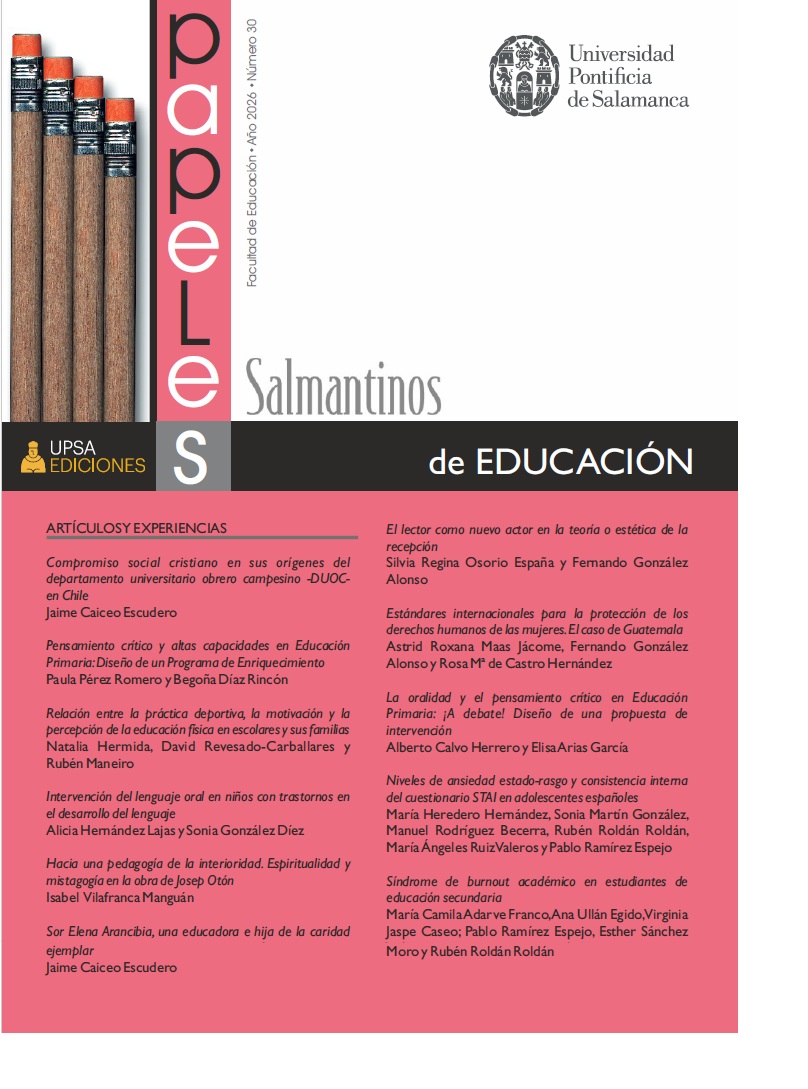
Emotional well-being during adolescence is a key factor in the school environment. Given the increase in academic pressure, accurate assessments of psychological distress are essential. The objective of this study was to analyze the psychometric properties of reliability and describe the anxiety profile (state and trait) in secondary school students. An observational, descriptive, and cross-sectional de-sign was used with a sample of 581 adolescents (M = 15.82 years; 52.7% females). The State-Trait Anxiety Inventory (STAI) was used for data collection. Internal con-sistency analyses showed good to acceptable reliability for both dimensions (Cronbach's Alpha = .833 for State Anxiety and .776 for Trait Anxiety). The descrip-tive analysis revealed low-to-moderate anxiety levels in the general sample, with the mean score in Trait Anxiety (M = 22.11) being higher than State Anxiety (M = 18.67). It is concluded that the evaluated students present a greater predisposition to anxiety as a stable personality trait rather than as a transitory state, and that the STAI is a reliable tool for its evaluation in this context.
Article Details
How to Cite
References
AlOtaibi, F. M. (2025). Breaking Barriers: Understanding Motivation and Anxiety in Saudi EFL Students. Journal of Research in Curriculum In-struction and Educational Technology, 11(1), 81-98. https://doi.org/10.21608/jrciet.2025.404426
Bernal, N. Y. P., Mayo, C. A., Chavarría, F. S., & Cruz, I. A. C. (2023). Re-lación entre el grado de ansiedad (autoevaluación de ansiedad estado/rasgo [STAI]) y el grado de trastorno temporomandibular (índice anamnésico de Fonseca) en una población mexicana. Revista ADM Órgano Oficial de la Asociación Dental Mexicana, 80(2), 89-95. https://dx.doi.org/10.35366/110648
Buela-Casal, G., Guillén-Riquelme, A. S. C. N., & Seisdedos Cubero, N. (2011). Cuestionario de ansiedad estado-rasgo: Adaptación española. Ma-drid: TEA ediciones.
Caldwell, D. M., Davies, S. R., Hetrick, S. E., Palmer, J. C., Caro, P., López-López, J. A., Gunnell, D., Kidger, J., Thomas, J., French, C., Stockings, E., Campbell, R., & Welton, N. J. (2019). School-based interventions to pre-vent anxiety and depression in children and young people: a systematic review and network meta-analysis. The Lancet Psychiatry, 6(12), 1011-1020. https://doi.org/10.1016/S2215-0366(19)30403-1
Caro, Y., Trujillo, S., & Trujillo, N. (2019). Prevalencia y factores asociados a sintomatología depresiva y ansiedad rasgo en estudiantes universitarios del área de la salud. Psychologia. Avances de la disciplina, 13(1), 41-52. https://doi.org/10.21500/19002386.3726
Del Río-Olvera, F. J., Cabello-Santamaría, F., Cabello-García, M. A., & Ara-gón Vela, J. (2018). Cuestionario de Ansiedad Estado Rasgo (STAI): aná-lisis psicométrico y funcionamiento en una muestra de drogodependientes y controles. Universitas psychologica, 17(1), 80-89.
Domenech, B. D., Martínez, M. T., Monteagudo, M. C. M., & Soria, I. N. (2024). Ansiedad social en la adolescencia: un estudio transnacional entre Francia y España. European journal of education and psychology, 17(1), 6. https://doi.org/10.32457/ejep.v17i1.2426
Domínguez, J., Pino, I. P., & Rodríguez, V. D. (2024). Ansiedad estado-rasgo: una aproximación desde la percepción de los adolescentes. Retos: nuevas tendencias en educación física, deporte y recreación, (60), 585-595. https://doi.org/10.47197/retos.v60.106903
Dove, C., & Costello, S. (2017). Supporting emotional well-being in schools: A pilot study into the efficacy of a mindfulness-based group intervention on anxious and depressive symptoms in children. Advances in Mental Health, 15(2), 172-182. https://doi.org/10.1080/18387357.2016.1275717
George, A. S. (2024). Exam season stress and student mental health: An inter-national epidemic. Partners Universal International Research Jour-nal, 3(1), 138-149. https://doi.org/10.5281/zenodo.10826032
Güemes-Hidalgo, M., Ceñal González-Fierro, M. J., & Hidalgo Vicario, M. I. (2017). Desarrollo durante la adolescencia. Aspectos físicos, psicológicos y sociales. Pediatría integral, 21(4), 233-244.
Guillén-Riquelme, A., & Buela-Casal, G. (2014). Metaanálisis de comparación de grupos y metaanálisis de generalización de la fiabilidad del cuestionario State-Trait Anxiety Inventory (STAI). Revista española de salud pública, 88, 101-112. https://dx.doi.org/10.4321/S1135-
57272014000100007
Hernández, O. L. (2024). Intervención socioemocional para el afrontamiento saludable del estrés en estudiantes de primaria. Revista Internacional de Educación Emocional y Bienestar, 4(1), 67-107.
https://doi.org/10.48102/rieeb.2024.4.1.69
Huttunen, I., Upadyaya, K., & Salmela-Aro, K. (2025). Adolescents’ social-emotional skills profiles, relationships at school, school anxiety, and educational aspirations. European Journal of Psychology of Education, 40(2), 57. https://doi.org/10.1007/s10212-025-00954-6
Ibacache, S., Scholz, V. Q., Laborda, M. A., San Martín, C., Rivera, F. A., & Miguez, G. (2024). Evaluación psicométrica del Inventario de Ansiedad Estado-Rasgo en adultos de Santiago: Resultados preliminares. Revista Ar-gentina de Ciencias del Comportamiento (RACC), 16(3), 127-128.
Jiménez-Mijangos, L. P., Rodríguez-Arce, J., Martínez-Méndez, R., & Reyes-Lagos, J. J. (2023). Advances and challenges in the detection of academic stress and anxiety in the classroom: A literature review and recommenda-tions. Education and information technologies, 28(4), 3637-3666. https://doi.org/10.1007/s10639-022-11324-w
Journault, A. A., Plante, I., Charbonneau, S., Sauvageau, C., Longpré, C., Giguère, C. É., Labonté, C., Roger, K., Cernik, R., Chaffe, K, E., Dumont, L., Labelle, R., & Lupien, S. J. (2022). Using latent profile analysis to un-cover the combined role of anxiety sensitivity and test anxiety in students’ state anxiety. Frontiers in Psychology, 13, 1035494. https://doi.org/10.3389/fpsyg.2022.1035494
Leal, P. C., Goes, T. C., da Silva, L. C. F., & Teixeira-Silva, F. (2017). Trait vs. state anxiety in different threatening situations. Trends in psychiatry and psychotherapy, 39(3), 147-157. https://doi.org/10.1590/2237-6089-2016-0044
Michuy, A. B. C. (2025). Gestión del clima escolar y su influencia en el ren-dimiento académico y el bienestar emocional de los estudiantes. SAGA: Revista Científica Multidisciplinar, 2(1), 74-87. https://doi.org/10.63415/saga.v2i1.33
Pop-Jordanova, N. (2019). Different Clinical Expression of Anxiety Disorders in Children and Adolescents: Assessment and Treatment. Contribu-tions/Prilozi (1857-9345), 40(1). https://doi.org/10.2478/prilozi-2019-0001
Ruiz, I. M., Quintero, M. J. B., González, C. L., Aguilar, J. C., & García, E. S. (2022). Prevención de los problemas socioemocionales en los centros educativos: una propuesta de intervención psicoeducativa. Revista de Orientación Educativa AOSMA, (31), 36-66.
Saviola, F., Pappaianni, E., Monti, A., Grecucci, A., Jovicich, J., & De Pisa-pia, N. (2020). Trait and state anxiety are mapped differently in the human brain. Scientific reports, 10(1), 11112. https://doi.org/10.1038/s41598-020-68008-z
Stromájer, G. P., Csima, M., Iváncsik, R., Varga, B., Takács, K., & Stromájer-Rácz, T. (2023). Stress and anxiety among high school adolescents: Cor-relations between physiological and psychological indicators in a longitu-dinal follow-up study. Children, 10(9), 1548. https://doi.org/10.3390/chil-dren10091548
Spielberger, C. D. (1970). Manual for the State-Trait Anxiety Inventory (self-evaluation questionnaire). (No Title).
Trudo, R. G., del Valle, M. V., Pagano, C. M., Vernucci, S., Andrés, M. L., Coni, A. G., & Juric, L. C. (2022). Adaptación y Validación del Cuestio-nario de Dimensiones y Facilitadores del Compromiso Escolar para la es-colaridad primaria. Revista Argentina de Ciencias del Comportamiento (RACC), 14(1), 170-171.
Vage, A., Gormley, G., & Hamilton, P. K. (2025). The effects of controlled acute psychological stress on serum cortisol and plasma metanephrine con-centrations in healthy subjects. Annals of Clinical Biochemistry, 62(3), 165-173. https://doi.org/10.1177/00045632241301618
Valente, G., Diotaiuti, P., Corrado, S., Tosti, B., Zanon, A., & Mancone, S. (2025). Validity and measurement invariance of abbreviated scales of the State-Trait Anxiety Inventory (STAI-Y) in a population of Italian young adults. Frontiers in Psychology, 16, 1443375.
https://doi.org/10.3389/fpsyg.2025.1443375
Vanessa, B. Z. S., Sánchez, K. G. M., Michuy, C. L. V., Chambe, C. D. J. C., & Michuy, M. N. V. (2025). Cambios cognitivos y emocionales en la ado-lescencia: una mirada desde la psicología evolutiva. Polo del Conoci-miento, 10(8), 465-477. https://doi.org/10.23857/pc.v10i8.10157
World Medical Association (2013). Declaration of Helsinki: Ethical principles for medical research involving human subjects. JAMA, 310(20), 2191–2194. https://doi.org/10.1001/jama.2013.281053