
Open to the external: Enactivism, non-propositional knowledge and virtue epistemology
Article Sidebar
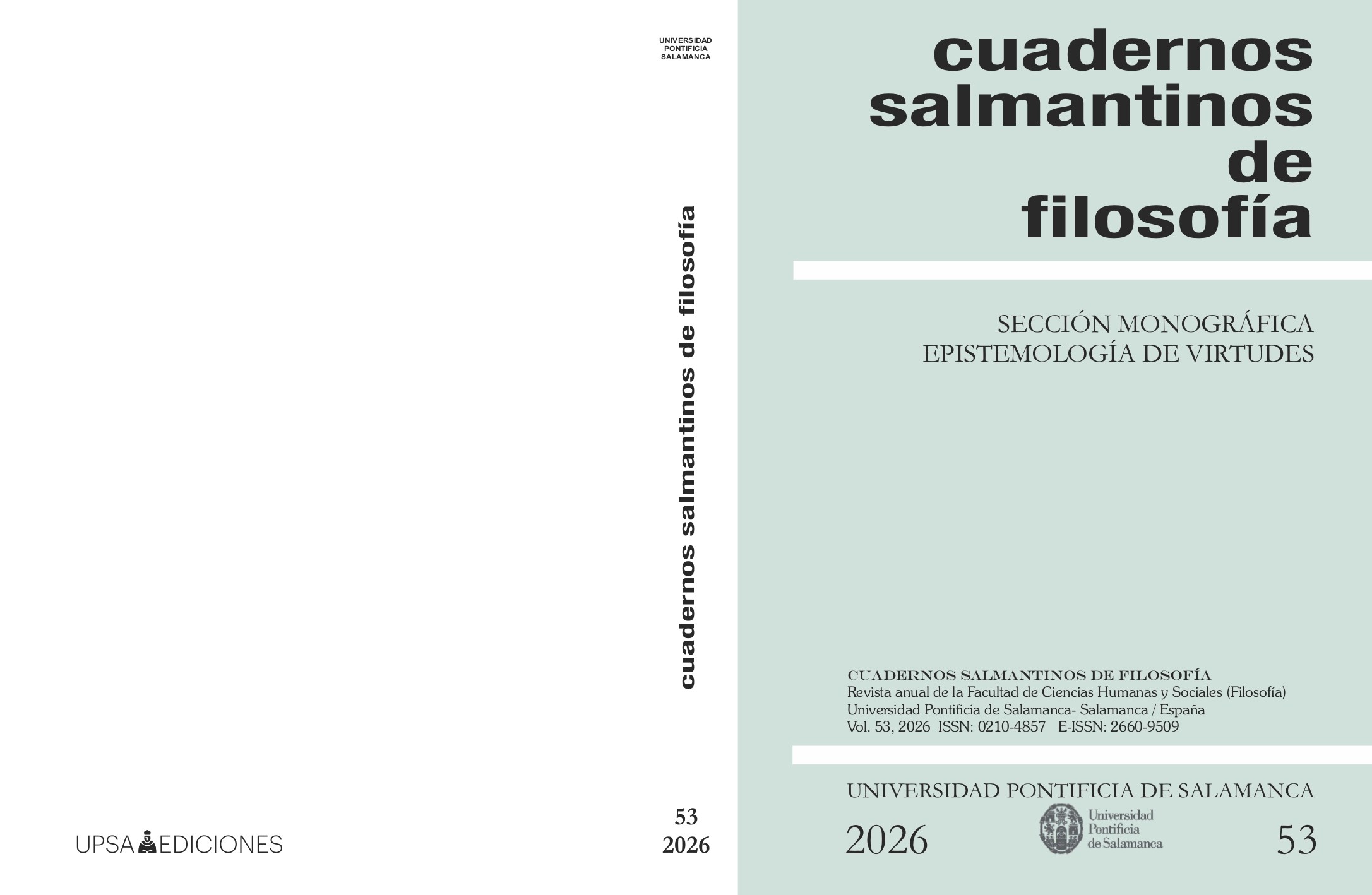
Main Article Content
In contemporary epistemology, the balance of the classic debate between epistemic internalism and externalism tilts more heavily toward the externalist side, due to the strength of positions such as virtue epistemology, which offers sufficiently clear criteria of epistemic normativity to determine what constitutes knowledge and what counts as justification. However, virtue epistemology—along with other positions concerning knowledge and justification, including internalist ones—is grounded on a presupposition that, if questioned, destabilizes the traditional concept of justification. For this reason, this paper challenges the central role of propositional representation that the epistemological tradition has established as a foundational pillar of knowledge, as well as the figure of the closed epistemic agent that this view presupposes, from an enactivist standpoint that rethinks the concept of justification. Therefore, the aim will be to contribute to virtue epistemology through a shift in perspective, which recovers non-propositional knowledge as a critique of representationalism.
Article Details
How to Cite
References
Brentano, F. C. (2020). Psicología desde el punto de vista empírico. (S. Sánchez-Migallón. Trad. y presentación). Sígueme. (Obra original publicada en 1874) 318 pp.
Fridland, E. (2013). Problems with intellectualism. Philosophical Studies, 165(3), 879–891. https://doi.org/10.1007/s11098-012-9994-4
Gallagher, S. (2017). Enactivist interventions. Oxford University Press. https://doi.org/10.1093/oso/9780198794325.001.0001
Gettier, E. L. (1963). Is Justified True Belief Knowledge? Analysis 23(6), 121-123. https://doi.org/10.1093/analys/23.6.121
Gómez-Alonso, M. (2019): Epistemología de virtudes. En Enciclopedia de la Sociedad Española de Filosofía Analítica. Recuperado de http://www.sefaweb.es/epistemologia-de-virtudes/
Gómez-Alonso, M. (2022): Introducción. En E. Sosa, Juicio y agencia (pp. 9-33). Prensas de la Universidad de Zaragoza.
Grimaltos, T. (2018). Internismo y externismo en epistemología. En Enciclopedia de la Sociedad Española de Filosofía Analítica. Recuperado de http://www.sefaweb.es/internismo-y-externismo/
Hetherington, S. C. (2011). How to know: A practicalist conception of knowledge. WileyBlackwell.
Hutto, D. D. (2008). Folk Psychological Narratives: The Sociocultural Basis of Understanding Reasons. Bradford Books.
Hutto, D. D. & Myin, E. (2017). Evolving Enactivism: Basic minds meet content (Kindle ed., p. 27). MIT Press.
Hutto, D. D. & Robertson, I. (2023). Against intellectualism about skill. Synthese 201(4):1-20. https://doi.org/10.1007/s11229-023-04096-4
Navarro, J. (2022): Saber-cómo (o saber hacer). En Enciclopedia de la Sociedad Española de Filosofía Analítica. Recuperado de http://www.sefaweb.es/saber-como
Noë, A. (2010). Fuera de la cabeza: Por qué no somos el cerebro y otras lecciones de la biología de la consciencia. Editorial Kairós.
Pappas, G. (2023). Internalist vs. externalist conceptions of epistemic justification". En E. N.
Zalta & U. Nodelman (Eds.), The Stanford Encyclopedia of Philosophy (Spring 2023 ed.). https://plato.stanford.edu/entries/justep-intext/
Pavese, C. (2022). Knowledge how. En E. N. Zalta y U. Nodelman (Eds.), The Stanford Encyclopedia of Philosophy (Fall 2022 ed.). https://plato.stanford.edu/archives/fall2022/entries/knowledge-how/
Ryle, G (1946). Knowing how and knowing that: The presidential address, Proceedings of the Aristotelian Society, 46(1): 1–16. https://doi.org/10.1093/aristotelian/46.1.1
Ryle, G (1949). The concept of mind, University of Chicago Press.
Sosa, E. (2022). Juicio y agencia. Prensas de la Universidad de Zaragoza.
Stanley, J., & Williamson, T. (2001). Knowing how. Journal of Philosophy, 98(8), 411–444. https://doi.org/10.2307/2678403
Steup, M. & Neta, R. (2024). Epistemology. En E. N. Zalta y U. Nodelman (Eds.), The Stanford Encyclopedia of Philosophy (Winter 2024 ed.). https://plato.stanford.edu/entries/epistemology/
Varela, F. J., Thompson, E., & Rosch, E. (2017). The embodied mind: Cognitive science and human experience (Rev. ed.). MIT Press