
Relationship between sports practice, motivation and perception of physical education in schoolchildren Implications for health promotion and occupational performance
Article Sidebar
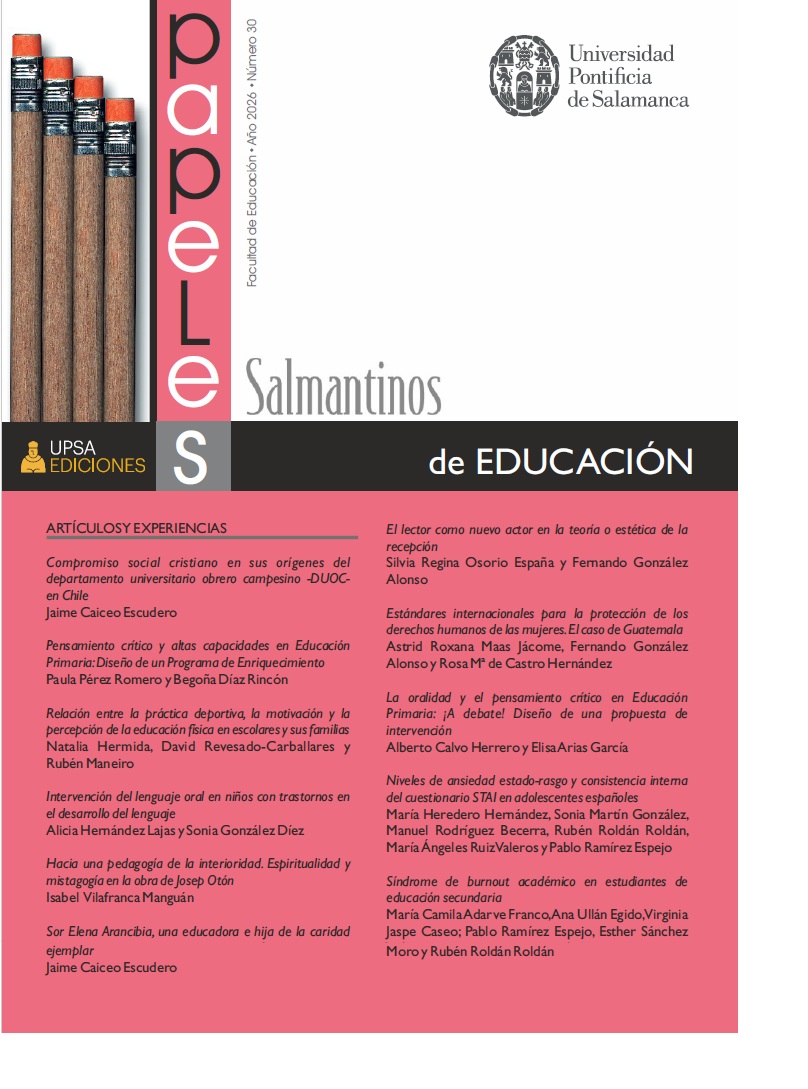
Main Article Content
The present study aimed to analyse sports participation, motivation towards physical activity, and perceptions of Physical Education among Primary Education students, as well as the views of their families. A cross-sectional descriptive design was conducted using two ad hoc questionnaires administered to students and their parents. The sample comprised 116 students. The results revealed a high level of sports participation, with 79.8% of the students regularly engaging in sports, pre-dominantly team sports. Regarding motivation, enjoyment was identified as the main reason for participation, followed by social influence and health. Furthermore, both sport and Physical Education were highly valued by the students, with more than half considering Physical Education to be their favourite school subject. From the fami-lies' perspective, both sport and Physical Education were also highly valued, together with a strong level of involvement in their children's sports participation. Neverthe-less, both students and families agreed that the current number of Physical Education lessons is insufficient. No significant gender differences were found in sports partici-pation. However, a strong positive relationship was identified between the importance attributed to sport and the perceived value of Physical Education. These findings rein-force the role of physical activity in promoting healthy lifestyles, participation in phy-sically active occupations, and the development of occupational performance during childhood, with important implications for health promotion and quality of life.
Article Details
How to Cite
References
American Occupational Therapy Association. (2020). Occupational therapy practice framework: Domain and process—Fourth edition. The American Journal of Occupational Therapy, 74(Supplement_2), 7412410010p1–7412410010p87. https://doi.org/10.5014/ajot.2020.74S2001
Bonilla, C. A., Fernández, S. E., Maneiro, R., y Moral, J. E. (2022). Análisis del autoconcepto en educación primaria, desde una perspectiva educativa y deportiva. Papeles Salmantinos de Educación, (26), 61-80.
Chancusig, L. H. C. (2023). La motivación como beneficio en las clases de educación física: Una revisión sistemática. MENTOR Journal of Educatio-nal and Sports Research, 2(5), 265-280.
Cuevas, E. D., Paramio-Pérez, G., & Almagro, B. J. (2016). Análisis de la motivación en las clases de Educación Física en Primaria. E-motion: Re-vista de Educación, Motricidad e Investigación, (7), 3-12.
De Vargas-Viñado, J. F. y Herrera-Mor, E. (2020). Motivación hacia la Edu-cación Física y actividad física habitual en adolescentes, Ágora para la Educación Física y el Deporte, 22, 187-208. DOI: https://doi.org/10.24197/aefd.0.2020.187-208
Fajardo, P., Alguacil, M., y González-Serrano, M. H. (2020). Variables pre-dictoras de la motivación deportiva en estudiantes de secundaria federados y no federados. Retos: Nuevas Perspectivas de Educación Física, Deporte y Recreación, 38.
Fradejas Medrano, E., y Espada Mateos, M. (2018). Evaluación de la motiva-ción en adolescentes que practican deporte en edad escolar. Retos, 33, 27-
33. https://doi.org/10.47197/retos.v0i33.52779
García de las Bayonas Plazas, M., y Baena-Extremera, A. (2017). Motivación en educación física a través de diferentes metodologías didácticas. Profe-sorado. Revista de Currículum y Formación del Profesorado, 21(1), 387–402. http://hdl.handle.net/10481/47514
Hermida Carballido, N. (2011). Actividad física y desempeño ocupacional en salud mental [Trabajo de fin de grado, Universidade da Coruña]. http://hdl.handle.net/2183/9050
Hosokawa, R., Fujimoto, M., & Katsura, T. (2023). Parental support for phy-sical activity and children’s physical activities: a cross-sectional study. BMC Sports Science, Medicine and Rehabilitation, 15(1), 90.
López, M. E. C., Navarro, R., y Camiño, S. B. (2015). ¿Qué tipo de motivación predomina en los escolares de educación primaria hacia la Educación Fí-sica? Un estudio descriptivo. EmásF: revista digital de educación física, (35), 152-160.
Martínez, A., Mayorga, D., y Viciana, J. (2016). Motivación hacia la Educa-ción Física y su relación con la condición física saludable en escolares de Educación Secundaria Obligatoria. Nutricion Hospitalaria, 33(4), 948-953.
Orain, C., Morgenthaler, T. & Schulze, C. Walking, talking, playing: Children with disabilities’ outdoor play in French mainstream schools. Scand. J. Oc-cup. Ther. 32, 1–13 (2025).
https://doi.org/10.1080/11038128.2025.2459150
Patón, R. N., Fernández, J. E. R., y Nemiña, R. E. (2016). Análisis de la satis-facción de las necesidades psicológicas básicas, motivación y disfrute en Educación Física en Primaria. Sportis: Revista Técnico-Científica del De-porte Escolar, Educación Física y Psicomotricidad, 2(3), 439-455.
Pérez-Pueyo, Á., Hortigüela, D., Fernández, J., Gutiérrez, C., & Rodríguez,
L. S. (2021). Más horas sí, pero¿cómo implantarlas sin perder el enfoque pedagógico de la Educación Física?(More hours yes, but how can they be implemented without losing the pedagogical approach of Physical Educa-tion?). Retos, 39, 345-353.
Revesado-Carballares, García-Lafuente y Maneiro-Dios. La educación para la salud en el contexto escolar: hábitos alimentarios y actividad física durante el recreo. EmásF, Revista Digital de Educación Física, (100), 21-32.
Rivas-Quarneti N, Viana-Moldes I, Veiga-Seijo S, Canabal-López M, Magal-haes L. Politicizing Children's Play: A Community Photovoice Process to Transform a School Playground. Am J Occup Ther. 2024 Jul 1;78(4):7804185100. doi: 10.5014/ajot.2024.050435. PMID: 38815193.
Ruiz Ortiz, I. (2023). Análisis de la motivación en Educación Física en Pri-maria según el tipo de profesorado. Retos: Nuevas Perspectivas de Educa-ción Física, Deporte y Recreación, 49.
Taylor, R. R., Bowyer, P., & Fisher, G. (2023). Kielhofner’s Model of Human Occupation: Theory and Application (6th ed.). Wolters Kluwer.
Vallejo, A. P., & González, J. M. (2012). Estudio sobre hábitos de actividad física saludable en niños de Educación Primaria de Jaén capital. Apunts Educación Física y Deportes, (107), 13-23.
Varela, I. G., Paramio-Pérez, G., y Almagro, B. J. (2019). Análisis de la mo-tivación en las clases de Educación Física de primer ciclo de Primaria. E-motion: Revista de Educación, Motricidad e Investigación, (12), 28-45.